Epidemics:ferguson2008
| Virtual society | Virus spread | Literature | Version 
|
|---|---|---|---|
| Polish virtual society epidemics model | |||
| Guinea pigs epidemics model | |||
| Virus genetic evolution epidemics model | |||
Contents
Cauchemez et al Model[1]
An example of so called SIR (Susceptible, Infectious, Recovered) model.
Joint probability of observed (Y), unobserved variables ( ), and parameters (
 ) is given by:
 ,
,
where:
 ,
,  prior level (prior distributions of the parameters of the model).
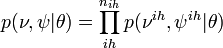 , transmission level
 , observation level
Y - indicator function:  (for ith, (
 ) individual of ihth household (of size
  ) on jth day (
 )), if clinical influenza was observed,
  otherwise.
  - all observations from household ihth, Y - observations from all households.
 - group of individuals at ihth household with at least 1 day of clinical influenza,
  - remaining members of the ihth household.
 - the 1st day of clinical influenza of ith individual in ihth household
 - unobserved variables corresponding to the start and the end of the infectious period for ith individual of ihth household
Observation level - parameters
![p(Y|\nu,\psi)=\left\{\begin{array}{ll}
1, & \textrm{if\;for\;all\;infected\;}i\,(i\in I): \nu_i\in [Z_i-3,Z_i] \land \nu_i < \psi_i\\
0, & \textrm{otherwise}
\end{array} \right.](/images/math/8/4/1/84177b6b9d5f65471dd2cf3d05c5bb89.png)
This level ensured that the unobserved data, , agreed with observed data, Y.
Transmission level - parameters 
The instantaneous risk of infection for an individual at time t in household of size n:
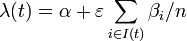 ,
,
where  - instantaneous risk of infection from the community and within household, respectively.
 - the group of infectives just before time t.
The duration of infectious period for ith infective  is taken from the gamma distribution with mean
  and standard deviation
  .
.
With the above, conditional on the date of the first infection  , we have (for the household):
![p(\nu,\psi|\theta)\,=\,\prod_{i\in I}\,d_{\mu_i,\sigma_i}(\psi_i-\nu_i)\prod_{i\in I-\{1\}}\,\lambda_i(\nu_i)\exp[-\int_{\nu_1}^{\nu_i}\lambda_i(t)dt]\,\prod_{s\in S}\exp[-\int_{\nu_1}^{15}\lambda_s(t)dt]](/images/math/0/7/8/078bfa5057da059d963a2770eb8eb196.png)
where I-{1} denotes infectives without the first infected
Prior level
That is prior distributions of all parameters, 
References
- ↑ CAUCHEMEZ S, Carrat F, Viboud C, Valleron A J, Boelle P Y, A Bayesian MCMC approach to study transmission of influenza: application to household longitudinal data, Stat. Med., 23, (2004), p3469
